WEEK OF JUL 26 – AUG 1, 2025

355B of free weights landed the same day Tesla committed $16.5B to silicon

Zhipu's MIT-licensed GLM-4.5, Manus's 100-agent fan-out, Deep Think for Ultra subscribers, an agentic Edge, and a foundry deal that pre-books a generation of accelerators.

The week's center of gravity was open weights and agent plumbing, not a flagship launch. On Monday 28 July Z.ai published GLM-4.5 — 355B total parameters, 32B active, MIT license, $0.11 per million input tokens — hours before Tesla disclosed a $16.5B contract handing Samsung's Texas fab over to its AI6 chip. Cheap intelligence and pre-booked silicon moved in the same news cycle.

Agent infrastructure moved too. Manus shipped Wide Research on Thursday, fanning one request across 100+ concurrent subagents; Microsoft turned Edge into an agent harness with Copilot Mode on Monday; OpenAI pushed ChatGPT Study Mode on Tuesday. On Friday Google started giving AI Ultra subscribers Gemini 2.5 Deep Think, a faster cut of the model that won IMO gold.

Nothing here is a frontier leap. It is the layer underneath — licenses, per-token prices, fan-out architectures, browser permissions, foundry bookings — hardening while the labs' model releases paused between cycles.

FRI · Aug 1, 2025modelsreasoningtest-time compute

Gemini 2.5 Deep Think ships to Google AI Ultra subscribers, capped below IMO gold

Google began rolling out Gemini 2.5 Deep Think in the Gemini app on 1 August, toggled on from the prompt bar and gated to Google AI Ultra subscribers. The model uses extended, parallel thinking — generating and evaluating several lines of reasoning at once — plus new reinforcement-learning techniques, and Google says it is a measured improvement over the version announced at I/O in May. It is a variation of the model that reached gold-medal standard at this year's International Mathematical Olympiad; the shipping version is faster and, on Google's internal 2025 IMO benchmark, reaches Bronze-level performance.

Google is simultaneously handing the full, slower IMO model to a select group of mathematicians and academics rather than to the paying tier, keeping the highest test-time-compute configuration out of the product. The gold-medal model took hours to reason through complex maths problems, which is precisely the trade the shipped version is solving for.

Gemini 2.5 Deep Think ships to Google AI Ultra subscribers, capped below IMO gold
storage.googleapis.com

WHY IT MATTERS

Deep Think is the clearest public statement that reasoning quality now scales with test-time compute budget and sampling strategy, not just weights: the parallel-sample-then-verify loop Google describes is reproducible in your own agent with a self-consistency or verifier pass, at a cost and latency you control rather than a vendor tier you buy.
THU · Jul 31, 2025agentsagent infrastructureorchestration

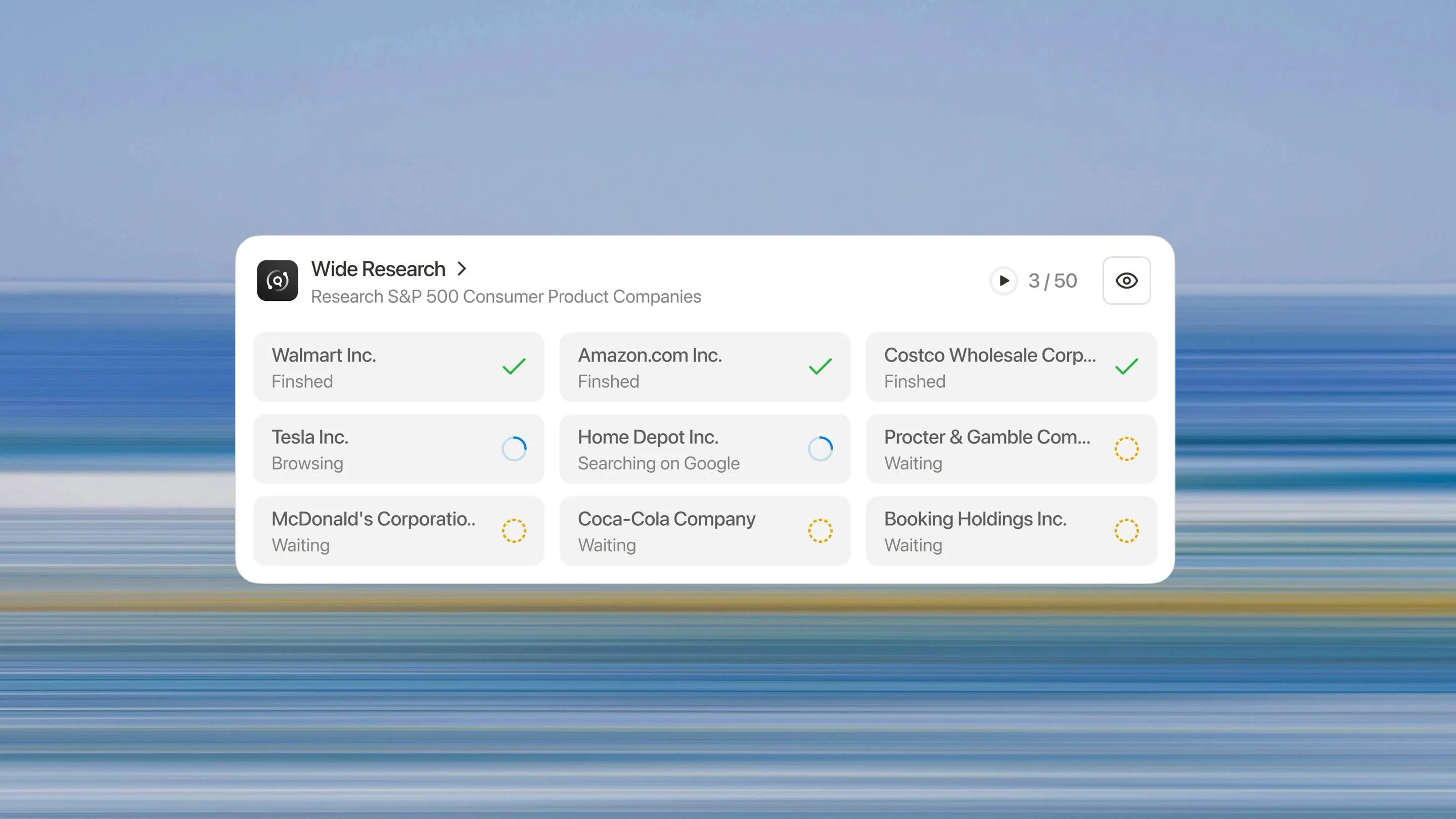
Manus Wide Research runs 100+ subagents on one task — fan-out, not depth

Manus announced Wide Research on 31 July, an experimental mode that spins up more than 100 concurrent subagents to attack a single high-volume task, then reassembles their output. In the launch demo, co-founder and chief scientist Yichao Ji compared 100 sneakers, with each subagent assigned one shoe's design, pricing and availability, returning a sortable matrix as a spreadsheet and web page within minutes. It switches on automatically for tasks that need wide-scale analysis rather than long single-trajectory digging, and shipped first for Pro subscribers.

The architectural claim is the interesting part: Manus says this is the first application of a virtualization and agent layer that scales compute 100x beyond its earlier platform, with agent-to-agent communication handled at system level instead of through hand-built specialist subagents — the opposite trade from OpenAI, Google and xAI deep-research designs that spend minutes to hours on one trajectory.

Manus Wide Research runs 100+ subagents on one task — fan-out, not depth
d1oupeiobkpcny.cloudfront.net

WHY IT MATTERS

A 100-way fan-out multiplies nondeterminism and spend by 100x, so anyone copying the pattern needs per-subagent budget caps, idempotent tool calls, deduplication, and an explicit merge and verification stage — output quality is bounded by the weakest merge step, not by the best subagent. It is also the pattern most likely to turn a fixed-cost feature into a variable-cost incident.

MON · Jul 28, 2025open weightsmodelspricing

Zhipu open-sources GLM-4.5: 355B parameters, 32B active, MIT license, $0.11/M input

Z.ai, formerly Zhipu AI, released GLM-4.5 on 28 July: a 355B-parameter mixture-of-experts model with 32B active parameters, alongside GLM-4.5-Air at 106B total and 12B active — base models, hybrid-reasoning models and FP8 builds all under the MIT license, downloadable from Hugging Face and ModelScope. Both are hybrid reasoning models with a thinking mode for complex reasoning and tool use and a non-thinking mode for fast replies, built as foundation models for agents rather than chat. On the company's twelve-benchmark average the flagship scores 63.2, which Z.ai places third overall and first among open-source models.

The price is the point: Z.ai lists API calls as low as $0.11 per million input tokens and $0.28 per million output tokens, with a high-speed tier above 100 tokens per second, while the weights themselves cost nothing to run on your own hardware. Z.ai reports 70.1% on TAU-Bench, 91.0% on AIME 24 and 64.2% on SWE-bench Verified with 128K context.

WHY IT MATTERS

MIT weights at 355B with 32B active mean a frontier-adjacent agent model can be self-hosted on a small GPU node or rented for cents per million tokens, which removes the price defense for closed APIs on tool-calling, retrieval and refactor workloads — and makes lock-in a design decision rather than a constraint.

MON · Jul 28, 2025agentsbrowserpermissionsproduct

Microsoft's Edge becomes an agent harness with Copilot Mode

Microsoft launched Copilot Mode in Edge on 28 July, an experimental mode that puts one AI surface over the new-tab page and the page you are on, and — with your permission — reads context across all your open tabs. It is opt-in, free for a limited time for users in Copilot markets on Windows and Mac, supports natural voice navigation, and Microsoft says Copilot can take actions such as comparing options across sites and opening tabs for you. Microsoft says history and credentials will be handed over soon so Copilot can book reservations and run errands on the user's behalf, with visual cues whenever it is working in the background.

The differentiator in the AI-browser race is not chat, it is acting inside a session you are already authenticated to. That makes the browser the most privileged tool surface a consumer agent has yet been handed, and Microsoft is explicitly collecting consent per capability rather than per site.

WHY IT MATTERS

If you build against browser sessions, cookies or autofill, this is the permission model you inherit: an agent with cross-tab context and account access needs scoping designed up front — per-tab context, explicit confirmations, and no credential delegation by default — because a prompt-injected page can now reach everything the user is logged into.

MON · Jul 28, 2025computehardwaresupply chain

Tesla signs $16.5B Samsung deal; a Texas fab goes all-in on the AI6 chip

Tesla signed a $16.5 billion contract to take its next-generation AI chips from Samsung, reported by Reuters and the WSJ on 28 July. Elon Musk had posted on X late on Sunday 27 July that Samsung's new Texas fab will be dedicated to making Tesla's AI6 chip, calling the strategic importance hard to overstate. Tesla's AI6 is its bet on a single all-in-one design that scales from supervised Full Self-Driving to the Optimus humanoid robot and up to data-center training.

The timing rhymes with the other 28 July headline: the same day 355B of agent-grade model weights went up for free under MIT, Tesla committed $16.5B to building accelerators. One half of the stack is being commoditized on price; the other is being pre-booked a generation ahead.

WHY IT MATTERS

Frontier inference capacity is increasingly sold through multi-year, single-customer bookings rather than spot availability, so the accelerators you rent and the price per token you pay next year are being shaped now. Plan compute commitments against published vendor roadmaps instead of assuming elastic on-demand supply.