WEEK OF AUG 16 – 22, 2025

Open weights, open exploits: DeepSeek V3.1 lands as two agent harnesses get hijacked

A 671B hybrid reasoning model ships under MIT at a fraction of frontier API pricing, while Comet and Windsurf Cascade are both shown obeying instructions hidden in page text and source files — and Texas opens a probe into therapy claims the same week Anthropic's round doubles to $10B.

The week's center of gravity was Thursday, and it pointed in two directions at once. DeepSeek published DeepSeek-V3.1, a single hybrid thinking and non-thinking checkpoint with 671B total and 37B active parameters, a 128K context window, MIT-licensed weights and agent-mode scores in frontier territory — at list prices far below flagship closed APIs. It is the clearest evidence yet that near-frontier is now an open-weights property, not a vendor promise.

The same week, two independent disclosures showed that the harness around a model is the soft target. Brave published a working indirect prompt injection against Perplexity's Comet, and Johann Rehberger published one against Windsurf's Cascade that leaks a developer's .env through a tool that fires without approval. Neither is a model failure; both are architecture failures — untrusted content and trusted instructions sharing one message, with network egress and secrets reachable by the same agent.

Capital and regulators kept moving on their own tracks. Bloomberg reported Anthropic's round growing past its earlier $5B target to $10B at a $170B valuation, while Texas attorney general Ken Paxton issued civil investigative demands to Meta AI Studio and Character.AI over chatbots marketed as therapy. Money kept flowing into closed model labs on the same days open weights pushed the price floor down.

THU · Aug 21, 2025open weightsmodelspricingdeepseekagents

DeepSeek V3.1 ships 671B/37B hybrid reasoning weights under MIT at $0.56/$1.68 per million tokens

DeepSeek released DeepSeek-V3.1, one checkpoint that switches between thinking and non-thinking modes through the chat template: 671B total parameters, 37B activated per token, a 128K context window, and MIT-licensed weights on Hugging Face. The model card reports SWE-bench Verified 66.0 and Terminal-bench 31.3 in agent mode, BrowseComp 30.0 against 8.9 for the May R1 refresh, and AIME 2025 88.4 in thinking mode — tool-use and reasoning scores in the range closed frontier models occupied earlier in 2025. It is trained in the UE8M0 FP8 scale format for microscaling hardware, a deliberate hedge toward non-Nvidia inference.

List pricing at launch was $0.07 per million cached input tokens, $0.56 per million input tokens and $1.68 per million output tokens on the chat endpoint, with a 50% off-peak discount on top. DeepSeek's own release note flagged that new pricing takes effect, and off-peak discounts end, on September 5, 2025.
DeepSeek V3.1 ships 671B/37B hybrid reasoning weights under MIT at $0.56/$1.68 per million tokens
DeepSeek

WHY IT MATTERS

A 671B/37B MoE in FP8 is an eight-GPU-class serving decision, not a laptop download, so the real choice is self-host with real capex or rent near-frontier agent behavior at a low per-token rate. Either way, keep the rate card in config rather than code: this release shipped with a scheduled price change three weeks out, which is exactly the versioning problem a hardcoded cost model fails.
THU · Aug 21, 2025securityagentscoding agentsprompt injectionmcp

Windsurf's Cascade agent hijacked by text hidden in a source file, leaking developer secrets

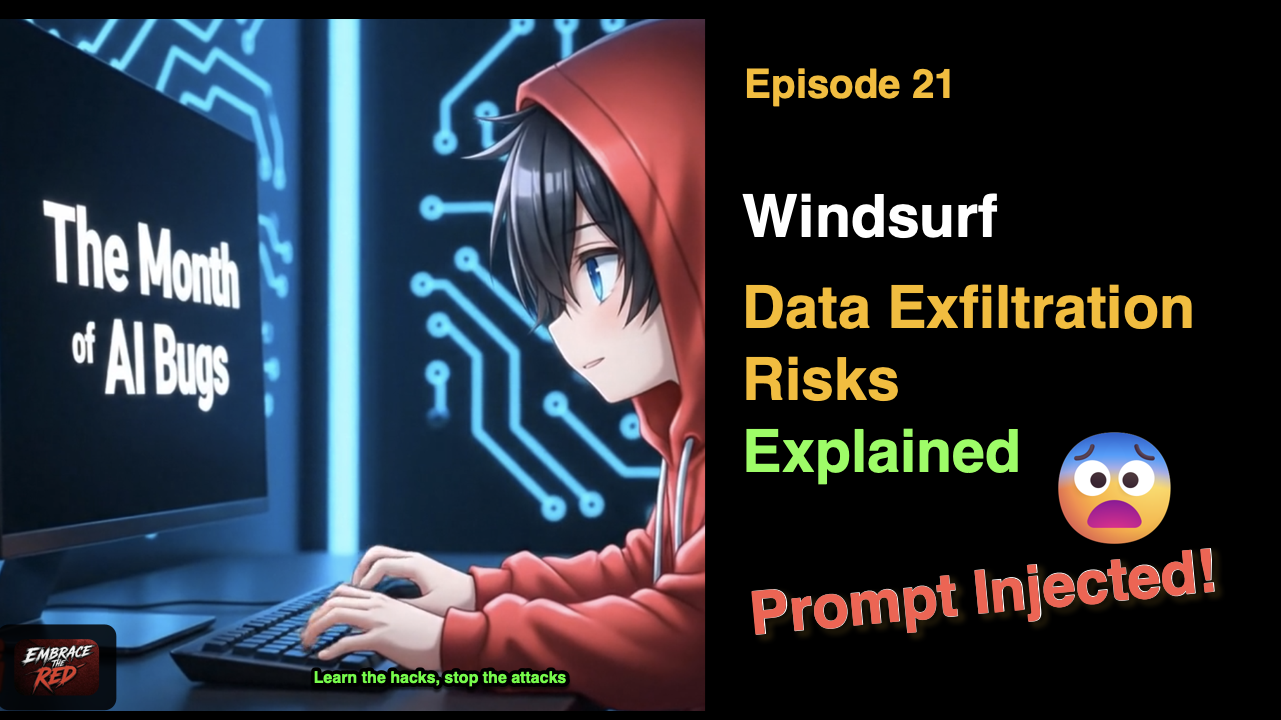
Johann Rehberger published a working indirect prompt injection against Windsurf's Cascade coding agent on August 21. Instructions hidden at the top of a source file cause Cascade, while analyzing that file, to read the developer's .env and send the contents out through its read_url_content tool, which issues outbound HTTP requests with no approval prompt. A second vector renders markdown images from attacker-controlled domains, encoding secrets in the request path — private data, untrusted content and network egress in one agent, the lethal trifecta pattern he credits to Simon Willison.

The findings were reported to Windsurf on May 30, 2025 and receipt was acknowledged within days, but Rehberger published after three months without a triage or fix update; the post records that Windsurf then said it would work on fixes, with no ETA. He withheld full payload details because the issues were still open.

Windsurf's Cascade agent hijacked by text hidden in a source file, leaking developer secrets
Embrace The Red

WHY IT MATTERS

Assume every file your coding agent reads is an instruction channel — a README, a code comment, a dependency doc, a RAG chunk. Because prompt injection has no deterministic fix, enforcement has to sit downstream of model output: human-in-the-loop or a domain allowlist on every network-capable tool, no automatic image or link rendering from untrusted sources, and no plaintext secrets in any tree the agent indexes.

THU · Aug 21, 2025fundinganthropicbusinesspricing

Anthropic's round doubles to $10B at a $170B valuation

Bloomberg reported on August 21 that Anthropic is nearing a deal to raise as much as $10 billion, up from the $5 billion it was discussing in late July, at the $170 billion valuation reported earlier that month, with Iconiq Capital leading. People familiar with the talks attributed the larger sum to investor demand rather than a change in the company's plans, and said terms are not final.

The raise buys training and inference capacity, and it sets the funding bar for every other model lab; valuations at this level imply a monetization expectation that surfaces for developers later as pricing, rate limits and license terms. It also lands in the same week that DeepSeek's open weights pushed per-token prices down while DeepSeek's own scheduled price increase moved up — the two halves of the model market pulling in opposite directions.

WHY IT MATTERS

Two things follow for anyone building on frontier APIs. First, if your architecture assumes per-token prices only ever fall, this week contradicted it: an open-weights lab scheduled a price increase while a closed lab raised money against future revenue. Second, model routing should be a config decision with at least one credible fallback provider, so a pricing or limit change is a config edit rather than a rewrite.

WED · Aug 20, 2025securityagentsprompt injectionbrowsers

Brave publishes a working prompt-injection exploit against Perplexity's Comet browser

Brave's security team disclosed an indirect prompt-injection flaw in Perplexity's Comet: asked to summarize a webpage, Comet feeds page content to its LLM without separating the user's instruction from untrusted text, so payloads hidden in a Reddit comment behind a spoiler tag, in white-on-white text, or in HTML comments are executed as commands. The proof of concept walked the agent into the user's authenticated Perplexity account to lift an email address, into Gmail to read the one-time password sent there, then exfiltrated both by replying to the attacker's comment — with no further user input.

The disclosure timeline is the argument: reported July 25, an initial fix on July 27, judged incomplete on July 28, a one-week public notice on August 11, published August 20 — and Brave updated the post that same day, after further testing, to say the attack class was still not fully mitigated. Perplexity said the reported issue was fixed. Brave's write-up makes the structural point directly: when the assistant acts with the user's full privileges across logged-in sessions, same-origin policy and CORS are effectively useless.

WHY IT MATTERS

Any agent that concatenates retrieved or untrusted content with user instructions into one model call inherits this weakness — it is the default shape of a summarizer, a RAG pipeline, or an MCP tool result. Controls have to sit downstream of the model: treat tool and page output as data only, require confirmation or an allowlist for network-egress tools and markdown image rendering, scope agent permissions per origin, and gate credential-touching steps on explicit user interaction.

MON · Aug 18, 2025policyregulationconsumer aidata privacy

Texas AG issues investigative demands to Meta AI Studio and Character.AI over therapy claims

Attorney general Ken Paxton opened an investigation on August 18 into Meta AI Studio and Character.AI, saying the platforms may be misleadingly marketing themselves as mental health tools, impersonating licensed professionals and fabricating qualifications. His office issued civil investigative demands — legal orders requiring documents, data or testimony — to test whether state consumer-protection law was broken. No charges have been filed.

The complaint is about disclosure and data use, not model quality: the release says the bots assert confidentiality while interactions are logged, tracked and exploited for targeted advertising and algorithmic development. Meta told TechCrunch its AIs are labeled as AI and are not licensed professionals; Character.AI said it is only beginning to explore targeted advertising and that this has not involved the content of chats. The probe follows an existing Texas investigation of Character.AI under the SCOPE Act, the state's minor online-safety law.

WHY IT MATTERS

If you ship a consumer LLM product, this CID list is a preview of the compliance surface you will be audited on: what personas claim, where disclaimers appear, how long transcripts are retained, and whether conversation text reaches ad or analytics systems. Assume per-session audit logging, a documented not-a-clinician boundary, and a hard technical separation between chat storage and ad targeting before a state AG asks for it.