WEEK OF FEB 7 – 13, 2026

Harness engineering became the discipline of the moment

OpenAI put a model on Cerebras at 1,000 tokens per second, two Chinese labs open-weighted frontier-adjacent coding models, and two independent posts proved the harness moves results more than the model.

This was the densest 24 hours of model news in months, and almost none of it was about raw intelligence. Google moved reasoning into the API, Z.ai and MiniMax shipped open weights within a day of each other, and OpenAI's first non-Nvidia production model made latency the axis of competition.

The story that will outlast the releases is smaller: two posts published a day apart, from opposite directions, showing that the edit tool and the harness — not the weights — were driving coding-agent results.

THU · Feb 12, 2026InferenceCoding agents

OpenAI puts a coding model on Cerebras at over 1,000 tokens/second

OpenAI released a research preview of GPT-5.3-Codex-Spark, a smaller sibling of GPT-5.3-Codex built for real-time coding and the first milestone of the OpenAI–Cerebras partnership. Served on Cerebras' Wafer Scale Engine 3, it delivers more than 1,000 output tokens per second, text-only with a 128k context, initially limited to design partners.

OpenAI also described the serving work behind it: a persistent WebSocket path in the Responses API cut per-roundtrip overhead by 80%, per-token overhead by 30% and time-to-first-token by 50%, with the WebSocket path becoming the default for all models.
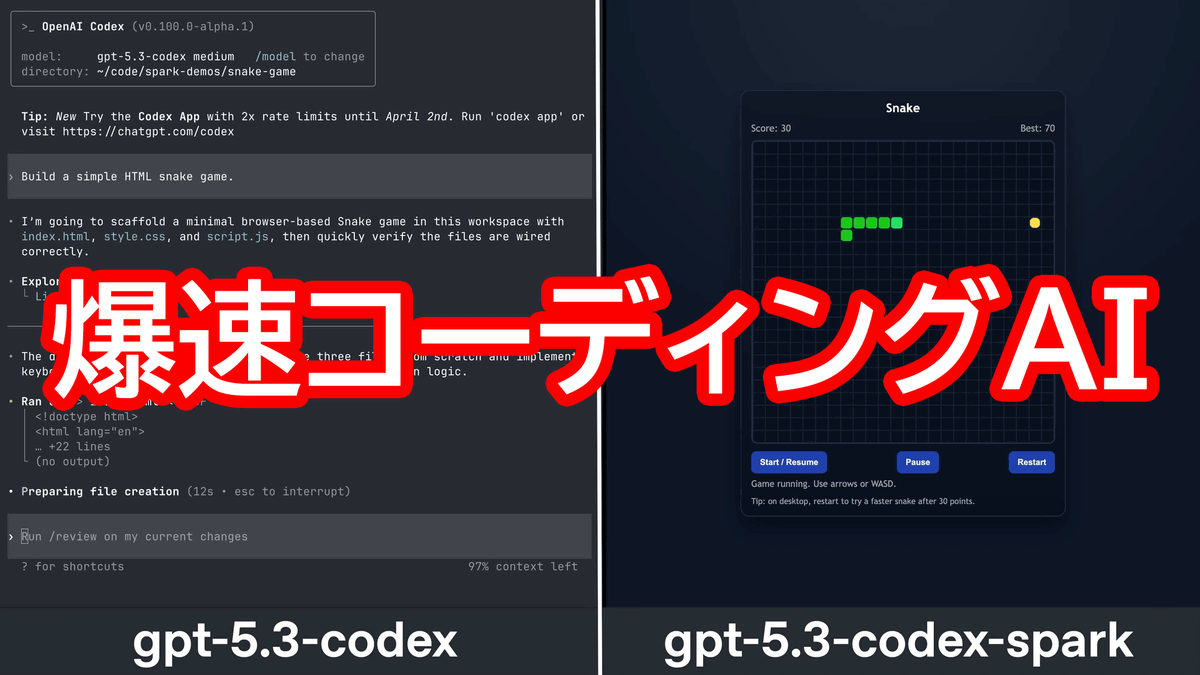
OpenAI puts a coding model on Cerebras at over 1,000 tokens/second
i.gzn.jp

WHY IT MATTERS

It is OpenAI's first production model deliberately placed off Nvidia hardware, and it makes latency rather than capability the axis of competition for coding agents. The serving-stack changes matter to anyone paying for agentic loops, not just to Cerebras watchers.

THU · Feb 12, 2026ReasoningAPI

Gemini 3 Deep Think reaches the API for the first time

Google released a major upgrade to Gemini 3 Deep Think, its specialized reasoning mode, positioned for science, research and engineering problems that “lack clear guardrails or a single correct solution.”

It rolled out to Google AI Ultra subscribers in the Gemini app, and for the first time became available through the Gemini API via an early-access program. Google reports 50.5% on CMT-Benchmark in advanced theoretical physics.

WHY IT MATTERS

A specialized reasoning mode reaching the API is the practical signal: long-horizon deliberation becomes programmable rather than locked to a consumer subscription, which opens multi-step reasoning inside pipelines.

THU · Feb 12, 2026FundingIndustry

Anthropic raises $30B at a $380B valuation

Anthropic closed a $30 billion Series G led by GIC and Coatue, valuing the company at $380 billion post-money — more than double its September valuation.

The company disclosed that Claude Code's run-rate revenue passed $2.5B, that weekly active Claude Code users doubled since January 1, and that enterprise use is now over half of Claude Code revenue. It cited an analysis estimating 4% of all public GitHub commits were authored by Claude Code. It also opened a research preview of a Model Hardware Standard, a shared spec for agents operating physical devices.

WHY IT MATTERS

The commit-share and run-rate numbers are the concrete ones: an AI coding tool is now a material fraction of public open-source activity, which changes assumptions about review load, provenance and licensing.

WED · Feb 11, 2026HarnessesBenchmarks

Two posts, one argument: the harness is the lever

OpenAI's Ryan Lopopolo published “Harness engineering: leveraging Codex in an agent-first world,” describing five months of building an internal product with zero hand-written code: roughly a million lines, about 1,500 merged PRs from a team of three engineers driving Codex, delivered in an estimated one-tenth the time of hand-writing it.

A day later Can Bölük's “The Harness Problem” benchmarked 16 models across three edit-tool formats and found the format, not the model, drove the results: Grok Code Fast 1 went from 6.7% to 68.3% after switching off patch-style edits, MiniMax more than doubled, and Grok 4 Fast's output tokens fell 61% once it stopped burning tokens on retry loops. Patch failure rates on models not trained for Codex-style diffs reached 50.7%.

Two posts, one argument: the harness is the lever
stencil.so

WHY IT MATTERS

Two independent posts made the same argument from opposite directions: the unit of engineering is now model plus harness, and the harness side is where control, verification and cost live. That is the highest-leverage place for a developer to spend effort, and it is measurably cheaper than swapping models.

WED · Feb 11, 2026Open weightsPost-training

Open-weight one-two punch: GLM-5 and MiniMax M2.5

Z.ai released GLM-5 under the MIT license, scaled from GLM-4.5's 355B to 744B parameters with pretraining data up from 23T to 28.5T tokens, integrating DeepSeek Sparse Attention to cut deployment cost. It was trained on “slime,” an asynchronous RL infrastructure.

A day later MiniMax shipped M2.5, a 229B MoE with 10B active, posting 80.2% on SWE-Bench Verified and beating Claude Opus 4.6 on third-party harnesses. MiniMax reports it runs for about $1/hour at 100 tokens/sec and now writes 80% of newly committed code inside the company.

WHY IT MATTERS

Both labs credit post-training rather than architectural novelty — async RL, 200k+ real-world RL environments. M2.5's explicit harness-generalization results are the part to read: it was tuned to survive other people's agent scaffolding, which is exactly what independent harness benchmarks flagged as the failure mode.

TUE · Feb 10, 2026LeadershipxAI

xAI loses two more co-founders

xAI co-founders Tony Wu and Jimmy Ba resigned within roughly 48 hours of each other, leaving Musk's lab with half of its original twelve. Reuters reported the exits are the latest in an exodus building over the past year; the Financial Times reported Ba's resignation followed tension inside the technical team over demands to improve model performance.

The departures came days after SpaceX said it would purchase xAI to create a $1.25 trillion company planning to go public later in 2026.

WHY IT MATTERS

Founding-team attrition at this rate threatens execution on a roadmap already reported late, and the SpaceX absorption reframes xAI from an independent lab into a division whose IPO narrative is rockets, not models.

MON · Feb 9, 2026LeadershipSafety

A safety-researcher exodus, and OpenAI dissolves Mission Alignment

Mrinank Sharma, who led Anthropic's Safeguards Research Team, published his resignation letter on X, citing AI, bioweapons and “a whole series of interconnected crises,” and saying organizations “constantly face pressures to set aside what matters most.” He said he was moving back to the UK to study poetry.

The same day, OpenAI researcher Zoë Hitzig resigned as the company began testing ads in ChatGPT, and set out her reasons in a New York Times guest essay about manipulation risk. Two days later OpenAI dissolved the Mission Alignment team it created in September 2024, reassigning its seven members and giving lead Josh Achiam the new title of chief futurist — its second dedicated safety or mission unit stood down since 2024.

WHY IT MATTERS

This is the labor side of the frontier, and it is a diligence question rather than a product one. Three safety-adjacent structures changed in three days, which says more about institutional priority than any single resignation letter.