WEEK OF MAR 14 – 20, 2026

A trillion-dollar order book, GPT-5.4 mini, and a model that helped train itself

GTC put a $1T backlog on Blackwell and Vera Rubin and shipped an agent runtime to go with the silicon; OpenAI bought the default Python toolchain, and the White House asked Congress to preempt state AI law.

Nvidia's GTC keynote put purchase orders for Blackwell and Vera Rubin at $1 trillion through 2027 — double what it projected a year earlier — and shipped NemoClaw, an open stack for running OpenClaw agents on top of the silicon.

Underneath the keynote, the model wave was cheap and fast: GPT-5.4 mini and nano, Mistral collapsing three models into one, and MiniMax claiming its model ran 30–50% of its own reinforcement-learning workflow.

FRI · Mar 20, 2026policyregulationwhite-housepreemption

White House asks Congress to preempt state AI laws

The Trump administration released a National Policy Framework for Artificial Intelligence with companion legislative recommendations, urging Congress to establish a single federal standard and preempt state AI laws that impose undue burdens.

The framework covers child protection, community and infrastructure impact, intellectual property, free speech and anti-censorship, innovation and American AI dominance, workforce development, and preemption. It carves out state police powers for generally applicable laws such as child safety, consumer protection and fraud, plus state zoning authority for AI infrastructure, and calls on Congress to let data centers generate power on site rather than put ratepayers on the hook. It is a set of recommendations to Congress, not self-executing law.

WHY IT MATTERS

Preemption is the highest-stakes AI policy question of the year: it determines whether developers ship against one national compliance regime or fifty state ones.
THU · Mar 19, 2026industrym&adevtoolspythoncodex

OpenAI to acquire Astral — uv, Ruff and ty move into the Codex team

OpenAI announced an agreement to acquire Astral, the Rust-based Python tooling company behind uv, Ruff and ty, with the team joining OpenAI's Codex group.

Astral's Charlie Marsh wrote that the tools have grown to hundreds of millions of monthly downloads and that OpenAI will continue supporting the open-source projects after close. The deal is subject to regulatory approval; until it closes, the companies remain independent. All three tools are permissively licensed, so existing releases cannot be retroactively relicensed.

WHY IT MATTERS

OpenAI didn't buy a model — it bought the default Python developer loop, the exact surface a coding agent runs on. Anthropic bought Bun in December 2025 for the same reason.

WED · Mar 18, 2026trainingpost-trainingrlagentsminimax

MiniMax M2.7 claims to have helped train itself — 30–50% of its own RL workflow

MiniMax released M2.7, a sparse MoE agentic coding and reasoning model of about 230B total and 10B active parameters with a 205k context, whose headline claim is early echoes of self-evolution.

An internal version of M2.7 acted as an autonomous researcher inside MiniMax's own reinforcement-learning pipeline, reading logs and loss curves, debugging data-pipeline failures, adjusting hyperparameters and proposing its next experiments through a three-part harness: markdown short-term memory, self-critique and self-optimization. MiniMax says that covered an estimated 30–50% of the RL workflow, with humans making the key decisions, and reports 56.22% on SWE-Pro and a 66.6% medal rate on MLE-Bench Lite after a 25-hour recursive-evolution run. M2.7 also ships native Agent Teams support.

WHY IT MATTERS

The most concrete public example of a harness-plus-memory loop improving a model's own training pipeline. Read the framing carefully though: bounded scaffold optimization inside a controlled pipeline, not open-ended self-training.

TUE · Mar 17, 2026model-releaseopenaiinference-efficiencycost

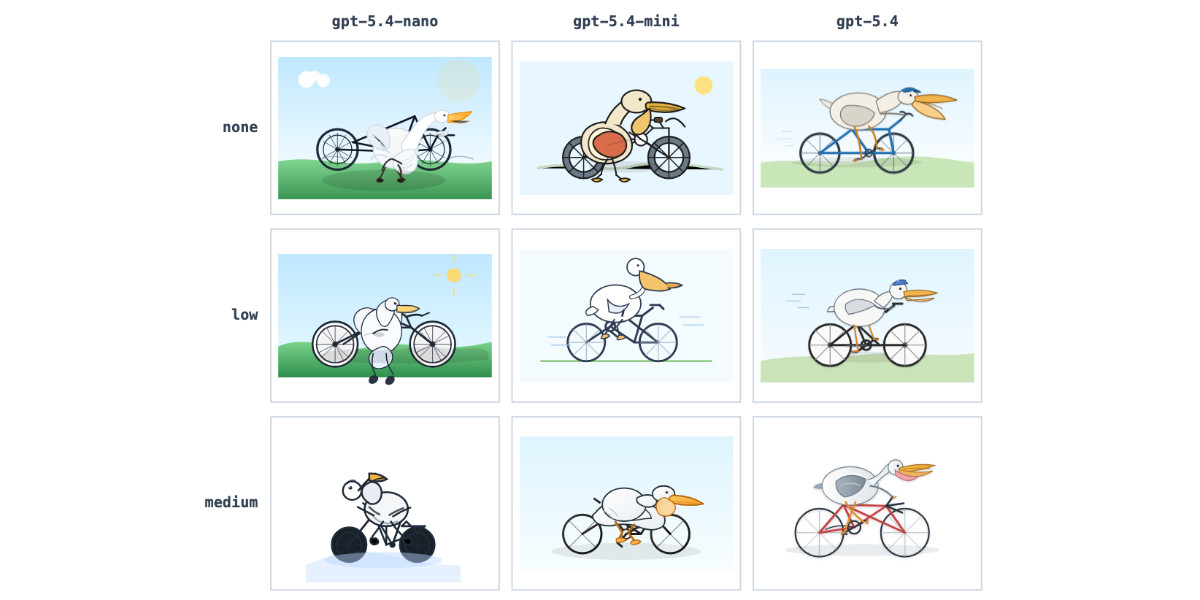
OpenAI ships GPT-5.4 mini and nano: reasoning for free users, subagent-sized prices

OpenAI released GPT-5.4 mini and nano, described as its most capable small models, targeting high-volume workloads and subagents.

mini runs more than 2x faster than GPT-5 mini and approaches the full GPT-5.4 on some evals — 72.1% on OSWorld-Verified versus 75.0% for GPT-5.4 and 42.0% for GPT-5 mini. nano is API-only at $0.20 per 1M input and $1.25 per 1M output tokens, undercutting Gemini 3.1 Flash-Lite on input. In ChatGPT, mini is available to Free and Go users and serves as the rate-limit fallback for GPT-5.4 Thinking on paid tiers.

OpenAI ships GPT-5.4 mini and nano: reasoning for free users, subagent-sized prices
static.simonwillison.net

WHY IT MATTERS

Cheap, fast small models are what actually make multi-agent fan-out affordable — nano's price and mini's OSWorld jump are the numbers that decide whether an agent-per-task architecture pencils out.

MON · Mar 16, 2026infrastructurehardwareagentsnvidiagtc

Nvidia's GTC keynote: $1T in Blackwell + Vera Rubin orders, and NemoClaw to run the agents

At GTC 2026 in San Jose, Jensen Huang said purchase orders for Blackwell and the next-gen Vera Rubin platform will reach $1 trillion through 2027 — double the $500B opportunity Nvidia projected a year earlier.

Vera Rubin was detailed as a seven-chip, five-rack-scale-system platform (Vera CPU, Rubin GPU, BlueField-4 STX, NVLink 6, ConnectX-9, Spectrum-6, Groq 3 LPU), with Nvidia claiming up to 10x lower cost per token and 3.3x the inference performance of Blackwell Ultra GB300 NVL72 — vendor figures, not independent benchmarks.

The software half matters as much: NemoClaw, an open-source stack for OpenClaw agents (Nemotron open models plus the OpenShell sandbox runtime), and the Nemotron Coalition of six frontier open model families spanning language, world and vision, robotics, driving, biology and weather.

Nvidia's GTC keynote: $1T in Blackwell + Vera Rubin orders, and NemoClaw to run the agents
image.cnbcfm.com

WHY IT MATTERS

The clearest statement yet that the bottleneck moved from training to inference throughput, and that Nvidia intends to sell the agent runtime as well as the accelerator.

MON · Mar 16, 2026model-releaseopen-weightmoeserving-efficiencymistral

Mistral Small 4: one Apache-2.0 model that collapses instruct, reasoning and agentic coding

Mistral released Small 4 under Apache 2.0, its first model to merge Magistral, Pixtral and Devstral into a single 119B-parameter MoE with 6B active parameters per token and a 256k context window.

A new reasoning_effort parameter toggles between none for low-latency chat and high for step-by-step reasoning. Mistral reports a 40% reduction in end-to-end completion time in its latency-optimized setup and 3x more requests per second versus Mistral Small 3, at $0.15 per 1M input and $0.60 per 1M output tokens. It shipped day-0 as an NVIDIA NIM.

WHY IT MATTERS

A single open-weight model covering chat, reasoning and coding-agent work at 6B active parameters is a real serving-efficiency story — one deployment instead of three, with reasoning cost dialed per request.