WEEK OF JUN 27 – JUL 3, 2026

Anthropic gets its models back, an open-weight model lands in Copilot, and the UN ships its first AI assessment

An 18-day government blackout ended, the first openly licensed model appeared in the world's most-used coding assistant, and 40 UN experts warned that safeguards are not keeping pace.

Anthropic restored Claude Fable 5 and Mythos 5 globally on July 1 after Commerce withdrew the June 12 export controls — one day after shipping Claude Sonnet 5 as its new agent-oriented default.

GitHub put the first open-weight model ever into Copilot's picker. Meta open-sourced a non-invasive brain-to-text pipeline that jumped decoding accuracy from single digits to 61%, and a 40-member UN panel published the first global scientific assessment of AI.

WED · Jul 1, 2026policyexport controlsanthropicsafetyagents

Anthropic's Fable 5 and Mythos 5 come back online as Commerce lifts export controls

Anthropic said it received notice on June 30 that the Commerce Department's Bureau of Industry and Security had withdrawn the June 12 export controls that forced it to disable its two most capable models worldwide, because the order barred access by foreign nationals including its own non-citizen staff.

Fable 5 returned globally on July 1 across the Claude Platform, Claude.ai, Claude Code and Claude Cowork, included for up to 50% of weekly usage limits through July 7 before moving to usage credits, with AWS, Google Cloud and Microsoft Foundry re-enablement to follow. Anthropic said a newly trained classifier blocks the reported bypass technique — found by Amazon researchers — in more than 99% of cases, and that blocked requests fall back to Opus 4.8, which it acknowledged will raise false positives on ordinary coding and debugging work. Commerce Secretary Howard Lutnick's letter stated a license is no longer required for export, reexport or in-country transfer of either model.

Anthropic's Fable 5 and Mythos 5 come back online as Commerce lifts export controls
cdn.sanity.io

WHY IT MATTERS

The first time US export-control authority was used against a commercially deployed frontier model rather than hardware. For agent builders it means a hardened front-door model, a documented fallback path, and a new precedent every lab now has to price in.
WED · Jul 1, 2026open weightsagent harnesscopilotmoonshottooling

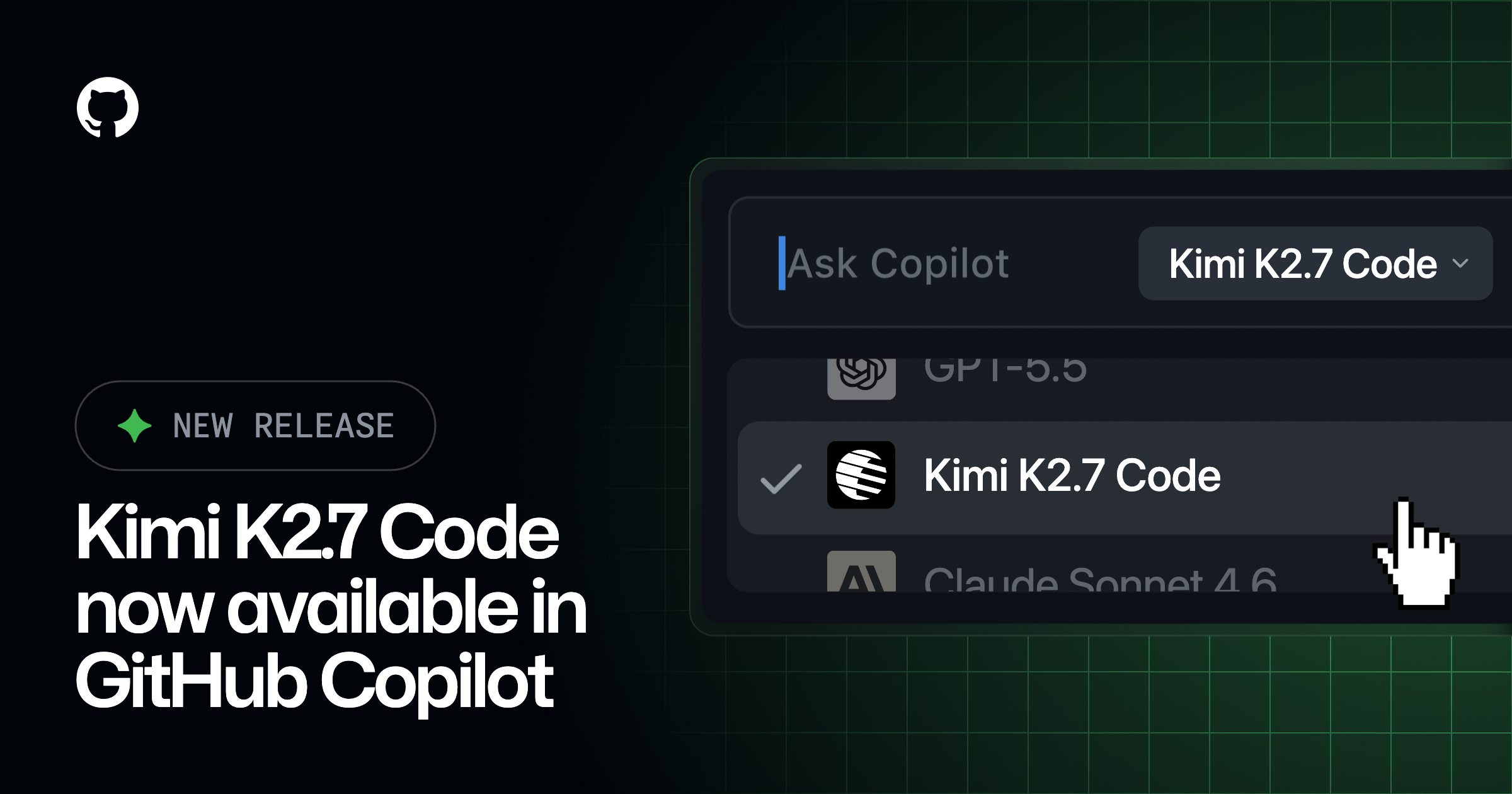
Kimi K2.7 Code becomes the first open-weight model in GitHub Copilot's picker

GitHub made Moonshot AI's open-weight Kimi K2.7 Code generally available in Copilot, calling it the first open-weight model offered as a selectable option in the Copilot model picker.

The model is hosted by GitHub on Microsoft Azure — requests never route through Moonshot — and is billed at provider list pricing under usage-based billing. It began rolling out to Copilot Pro, Pro+ and Max plans across VS Code, Visual Studio, JetBrains, Xcode, Eclipse, Copilot CLI, the Copilot cloud agent and github.com, with Business and Enterprise to follow. For those enterprise tiers GitHub left it off by default, requiring an administrator to enable the Kimi K2.7 policy, and advised admins to review open-weight models against their own security, compliance and data-governance requirements first.

Kimi K2.7 Code becomes the first open-weight model in GitHub Copilot's picker
GitHub

WHY IT MATTERS

An openly licensed Chinese-lab model is now a first-class, Azure-hosted option in the world's most widely used AI coding assistant, at a fraction of frontier pricing. It is a concrete test of whether open weights can win distribution against closed models in agent tooling.

WED · Jul 1, 2026policysafetygovernancealignmentun

UN's 40-expert scientific panel publishes first global AI assessment

The UN Independent International Scientific Panel on AI released its Preliminary Report, the first global, independent scientific assessment of AI, produced by 40 experts drawn from all five UN regions and co-chaired by Yoshua Bengio and Maria Ressa.

Its central warning is that current safeguards cannot keep pace with the growth of AI capabilities, and that policymakers face an evidence dilemma: by the time the science is clear, it may be too late to act. The report covers AI trajectories, societal applications in science, health, education and agriculture, economic implications, security and environmental impacts, human rights and democracy, and child safety, and singles out agentic systems as a governance step change. Findings were presented at the inaugural UN Global Dialogue on AI Governance in Geneva, ahead of a full report planned for 2027.

WHY IT MATTERS

The closest thing yet to an authoritative, government-facing consensus statement on where AI risk stands — including that the world lacks a reliable way to keep highly autonomous models under control.

TUE · Jun 30, 2026model releaseagentsanthropicpricingcoding agents

Claude Sonnet 5 ships as Anthropic's most agentic Sonnet yet — and the new default

Anthropic released Claude Sonnet 5, making it the default model for Free and Pro plans and available on Max, Team and Enterprise, in Claude Code and on the API as claude-sonnet-5.

Anthropic positions it as closing most of the gap with Opus 4.8 on agentic work at a lower price: introductory API pricing of $2 per million input tokens and $10 per million output tokens through August 31, 2026, then standard $3/$15. The model is built to plan, drive browsers and terminals, and run autonomously on multi-step tasks, with adjustable effort levels and a refreshed tokenizer. TechCrunch reported Anthropic citing 63.2% on an agentic coding benchmark versus Opus 4.8's 69.2% and Sonnet 4.6's 58.1%.

WHY IT MATTERS

Agentic capability is now table stakes at the mid tier, so the differentiator shifts to cost and reliability per task. A cheaper default model directly changes the economics of long-running agent loops.

TUE · Jun 30, 2026roboticshumanoidsdeploymentgoogle deepmindtraining data

Apptronik opens Robot Park and unveils Apollo 2, feeding data to Gemini Robotics

Google-backed Apptronik unveiled a nearly 90,000-square-foot robot training facility in Austin called Robot Park, developed with Google DeepMind, where fleets of humanoid robots run logistics, manufacturing and retail tasks to generate real-world training data.

The company also introduced Apollo 2, its latest humanoid, which has operated for more than a year as its data-collection platform and ships in both bipedal and wheeled configurations. Robot Park supplies data to Gemini Robotics under Apptronik's research partnership with Google DeepMind. CEO Jeff Cardenas described the setup as a factory that produces robots alongside a factory that produces data, said Apptronik has built hundreds of Apollo 2 units, and said real production versions arrive in 2027 and beyond.

WHY IT MATTERS

Humanoid progress is bottlenecked on real-world data, not model ideas. A dedicated data factory tied directly to a frontier robotics model is the clearest signal yet of how embodied AI will be scaled — and of who owns the data.

MON · Jun 29, 2026researchopen sourcebcisciencemeta

Meta open-sources Brain2Qwerty v2, tripling-plus non-invasive brain-to-text accuracy

Meta's FAIR team published Brain2Qwerty v2, a non-invasive pipeline that decodes typed sentences from magnetoencephalography recordings with no implant.

Trained on roughly 22,000 sentences from nine volunteers who each spent about 10 hours typing inside an MEG scanner, it reaches 61% average word accuracy and 78% for the best participant, versus roughly 8% for prior non-invasive methods — Meta reports a 29% character error rate for MEG against 65% for EEG. The architecture combines a convolutional encoder over raw brain signals, a transformer, and a character-level language model, with fine-tuned LLMs supplying semantic context and AI agents used to iteratively refine the decoding pipeline. Meta released the full training code for v1 and v2 and its partner BCBL released the v1 dataset.

WHY IT MATTERS

Non-invasive brain decoding has been stuck near useless accuracy for years while credible results came only from surgical implants. Getting to 61% on open code makes this a reproducible research baseline for anyone working on assistive interfaces.