DISPATCH

Everything that mattered in AI, one page a week.

Most AI news does not survive the week. This is the part that did — the releases, the research, and the shifts that actually change how we build. Designed & built to keep you up to date with things in AI without needing to be unemployed. Just refresh Saturday morning and review the last week's dispatch.

90 DISPATCHESWRITTEN EVERY FRIDAYNEXT UPDATE IN

DISPATCH 06

WEEK OF FEB 1 – 7, 2025

Congress moved to ban a model it cannot un-publish

An MIT-licensed reasoning model spread across Hugging Face in hundreds of community distills — and the legislative response was to ban an app. Meanwhile GitHub turned Copilot into a coding agent.

Bipartisan legislation to purge DeepSeek from US federal devices was introduced, targeting an app built on MIT-licensed weights that anyone can self-host. Hugging Face's Open R1 project published its first verified reproduction of DeepSeek's reported MATH-500 scores.

Agent tooling moved fast: OpenAI shipped the deep research agent and GitHub put agent mode plus its autonomous SWE agent on the roadmap. Alphabet and Amazon guided to a combined $175B of 2025 capex, and the EU published its prohibited-AI guidelines the same day Google deleted its weapons and surveillance pledges.

FRI · Feb 7, 2025open weightsdeepseekregulationexport controlsreasoning

Washington moves to ban the open-weight reasoning model it can't un-publish

Bipartisan legislation to purge DeepSeek from US federal devices was introduced: H.R.1121, the No DeepSeek on Government Devices Act, filed and referred to the House Oversight Committee. It would direct OMB to write standards requiring removal of the DeepSeek app from federal agency IT, and extends to any successor product built by the hedge fund that funds DeepSeek.

It follows a Senate bill that reporting said would attach jail time to downloading DeepSeek. The irony is the target: DeepSeek-R1 is an MIT-licensed, openly downloadable reasoning model, shipped with six open dense distills. This week the community reproduction wave proved the point — Hugging Face's Open R1 project reproduced DeepSeek's reported MATH-500 scores for the entire R1-Distill family, and had to build a public eval leaderboard because the models' roughly 6,000-token average responses were too long to evaluate casually.

Washington moves to ban the open-weight reasoning model it can't un-publish
Hugging Face

WHY IT MATTERS

Open weights reached frontier-adjacent reasoning quality and the response was legislative, not technical — that is the trade a self-hosted stack now lives in. A frontier-adjacent reasoning model that anyone can host is simultaneously a national-security item in Congress. Also a reminder that the derivative ecosystem (third-party distills, quantizations, community evals) is where an open model's real value compounds.

THU · Feb 6, 2025agentscoding agentsdeveloper toolsharness

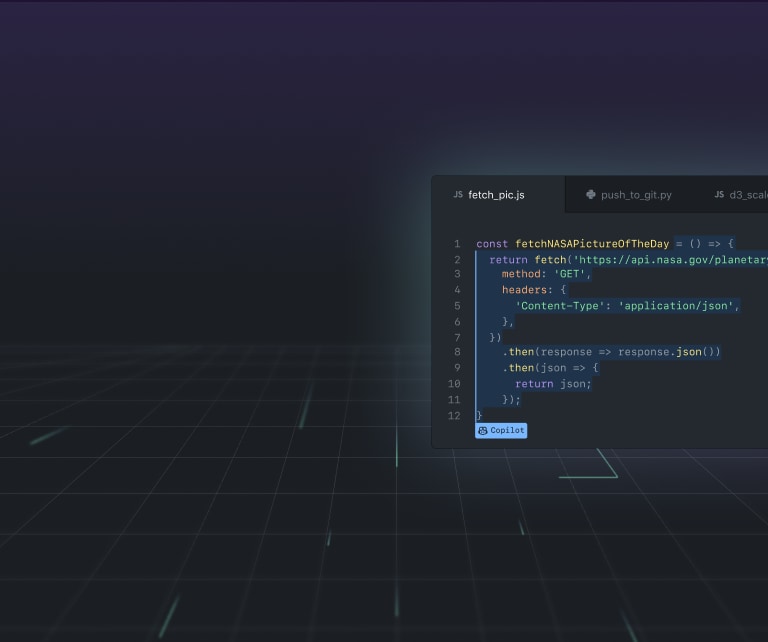
GitHub turns Copilot into a coding agent and teases Project Padawan

GitHub shipped the agentic era of Copilot: agent mode in VS Code iterates on its own output, recognizes and fixes errors, suggests terminal commands and does runtime-error self-healing; Copilot Edits went generally available for multi-file natural-language edits; next edit suggestions, shareable prompt files and screenshot-to-UI-code arrived in preview.

Gemini 2.0 Flash and OpenAI's o3-mini entered Copilot Chat in public preview with org-wide model controls, and GitHub gave a first look at Project Padawan — an autonomous SWE agent that takes an assigned issue and returns work for review.

GitHub turns Copilot into a coding agent and teases Project Padawan
images.ctfassets.net

WHY IT MATTERS

The harness, not the model, is the product: self-healing loops, multi-file edits, prompt files and admin-level model selection are exactly the permission and configuration surfaces an agent builder has to secure. Prompt files and stored instruction sets also become supply-chain targets the moment they are shared — which is the TrapDoor attack class, two years early.

THU · Feb 6, 2025computecapexdata centershyperscalers

Amazon plans ~$100B of 2025 capex for AI, after Alphabet's ~$75B

On its Q4 2024 earnings call Amazon said it expects about $100 billion of capital expenditures in 2025, with Andy Jassy calling AI a once in a lifetime opportunity and the vast majority of the spend going to AWS AI capacity.

Two days earlier Alphabet guided to roughly $75 billion of 2025 capex, largely for AI infrastructure, alongside Q4 revenue of about $96.5 billion — a quarter that slightly missed expectations and dragged shares. Two hyperscalers, $175B of committed 2025 spend between them, in the same week the industry debated whether cheap Chinese reasoning models made that spend unnecessary.

WHY IT MATTERS

Capex guidance is the clearest leading indicator of inference cost and GPU availability: what gets built in 2025 sets the price floor agent workloads pay in 2026, and the DeepSeek cost-shock debate is exactly the argument this spending is being defended against.

WED · Feb 5, 2025modelsgooglepricingcontext windowagents

Gemini 2.0 Flash goes GA, Flash-Lite arrives, 2.0 Pro opens up

Google made Gemini 2.0 generally usable: 2.0 Flash became generally available with higher rate limits and simplified single-rate pricing, 2.0 Flash-Lite entered public preview as the most cost-efficient Gemini yet, and 2.0 Pro landed as an experimental update aimed at coding and complex prompts.

The Flash tier ships a 1 million token context window, native tool use and multimodal input, with image and audio output promised. Google claims performance gains across benchmarks over Gemini 1.5 while cutting effective cost on mixed-context workloads — and the same day GitHub made 2.0 Flash available inside Copilot Chat.

WHY IT MATTERS

Million-token context with native tool calling at a cut rate is the cheapest place to run long-horizon agent loops this week. Flash-Lite also resets the price anchor for high-volume, low-reasoning agent subtasks like extraction, routing and summarization — the tier that decides whether a multi-agent fan-out pencils out.

TUE · Feb 4, 2025regulationeu ai actsafetyalignmentjailbreaks

EU publishes its prohibited-AI rules the same day Google deletes its weapons and surveillance pledges

The European Commission published its guidelines on the AI Act's prohibited practices, covering harmful manipulation, social scoring and real-time remote biometric identification, two days after the prohibitions themselves became applicable — the Act's first compliance deadline, with fines reaching €35M or 7% of global turnover once enforcement powers bite. The guidelines are non-binding; authoritative interpretation sits with the Court of Justice.

On the same day, Google removed from its AI principles the 2018 pledges not to use the technology for weapons development or surveillance. Also this week in safety research, Anthropic published Constitutional Classifiers, a synthetic-data guard that held up through more than 3,000 hours of human red teaming with no successful universal jailbreak in its target CBRN domain.

WHY IT MATTERS

European regulators were writing the binding interpretation of what AI must never do while a US frontier lab deleted its own self-imposed red lines. For anyone shipping agents into European markets the prohibited-practice list is now the compliance baseline, and guard-classifier results like Anthropic's are the cheap control that keeps a jailbreak from becoming a compliance event.

SUN · Feb 2, 2025agentsopenairesearch agentstool useevals

OpenAI launches the deep research agent, its first production autonomous worker

OpenAI released deep research in ChatGPT: an agent that plans, browses and synthesizes hundreds of sources over tens of minutes into a cited analyst-grade report, powered by a version of the upcoming o3 model optimized for web browsing and data analysis.

OpenAI ships it with full citation trails and a visible thinking summary. Rollout started with Pro, and was extended to Pro users in the UK, Switzerland and the EEA within days. Reporting on the launch benchmark put it around 26% on Humanity's Last Exam.

WHY IT MATTERS

This is the template for long-horizon research agents: budgeted browsing, citation fidelity, personal-data and prompt-injection exposure from arbitrary web pages, and per-query cost measured in tens of minutes of inference. Nobody shipped the harness, only the output — so the engineering lesson is that multi-hour, tool-using, self-pivoting search loops are now a consumer product tier.

DISPATCH 05

WEEK OF JAN 25 – 31, 2025

A downloadable model erased $593B from Nvidia, then everyone pushed back

DeepSeek's app took the top of the App Store and wiped nearly $600 billion off Nvidia in a single session. Within 72 hours a privacy regulator, a competitor, a security firm and a rival CEO had all responded.

Nvidia closed down about 17% on Monday, shedding close to $593 billion in market value — the largest single-day market-cap loss ever for a US company — as investors repriced the assumption that frontier AI requires ever-larger GPU fleets. The trigger was a free assistant built on the openly downloadable R1 model.

The response arrived from every direction: Italy's Garante blocked the service on GDPR grounds, Wiz found an unauthenticated production database leaking chat logs and API keys, OpenAI claimed DeepSeek distilled its models, and Anthropic's CEO argued the moment made chip export controls more important, not less.

FRI · Jan 31, 2025openaireasoningmodelsagent toolingsafety

OpenAI answers DeepSeek with o3-mini — and the first model rated Medium on autonomy

OpenAI released o3-mini in ChatGPT and the API, its cheapest reasoning model so far and the first small reasoning model with function calling, Structured Outputs and developer messages built in — the pieces agent builders actually wire together.

Three reasoning-effort levels let callers trade latency for depth. OpenAI says it produced math and factuality answers about 24% faster than o1-mini with 39% fewer major mistakes, tripled the Plus and Team limit from 50 to 150 messages per day, and put a reasoning model in front of free-plan users for the first time. There is no vision support. The accompanying system card rates CBRN, Persuasion and Model Autonomy Medium and Cybersecurity Low.

OpenAI answers DeepSeek with o3-mini — and the first model rated Medium on autonomy
Mistral AI

WHY IT MATTERS

The contrast is the story: six days after a free, openly downloadable Chinese reasoner broke the assumption that frontier quality requires frontier spend, OpenAI's counter was cheaper closed reasoning plus a safety scorecard that admits a real autonomy shift. For anyone building harnesses, the function calling, structured outputs and reasoning-effort surface matters more than the benchmark table — it makes a reasoning model usable as a tool-calling component rather than a chatbot.

THU · Jan 30, 2025open weightsmistralself-hostingefficiencyfunction calling

Mistral Small 3: a 24B Apache-2.0 model that runs on one RTX 4090 and matches Llama 3.3 70B

Mistral released Mistral Small 3, a latency-optimized 24B dense model under Apache 2.0 — both pretrained and instruction-tuned checkpoints, 32K context, native function calling and JSON output, with strong system-prompt adherence.

It scores above 81% on MMLU at roughly 150 tokens per second, and Mistral claims parity with Llama 3.3 70B at three times the parameter count while being more than 3x faster on the same hardware; quantized, it fits a single RTX 4090 or a 32GB MacBook. Notably it was trained without RL and without synthetic data, positioning it as a base for reasoning work rather than a finished reasoner. Mistral simultaneously recommitted to Apache 2.0 for general-purpose models, moving away from its restrictive MRL license.

Mistral Small 3: a 24B Apache-2.0 model that runs on one RTX 4090 and matches Llama 3.3 70B
Mistral AI

WHY IT MATTERS

A second frontier-adjacent open-weight release in the same week pushes the deployable cost floor down to one consumer GPU: agent-grade function calling with no per-token bill, no data leaving the machine, and no closed-lab terms of service. That is the practical version of the cheap-intelligence argument the market was repricing on Monday — and note the license change, which matters as much as the weights.

THU · Jan 30, 2025regulationexport controlsprivacydeepseekpolicy

Italy blocks DeepSeek; OpenAI alleges distillation; Amodei says controls matter more

Italy's data protection authority imposed an immediate and definitive limitation on DeepSeek's processing of Italian users' personal data after the two Chinese companies behind the app answered its questions in a way it called totally insufficient and argued the GDPR did not apply to them. The app had already disappeared from Italian app stores the previous day.

The same week, OpenAI told the FT it had evidence DeepSeek used its proprietary models to train R1 via distillation — a terms-of-service violation — and the White House AI and crypto czar said there was substantial evidence it had happened. On 29 January Anthropic CEO Dario Amodei published an essay arguing DeepSeek's cost figures were on-trend at best rather than a discontinuity, that R1 essentially replicates OpenAI's o1 RL approach, and that cheaper training makes chip controls more important because million-chip clusters cannot be smuggled the way thousands can.

WHY IT MATTERS

This is the week's explicit contrast: an openly downloadable model anyone can self-host, landing next to a privacy regulator shutting the service down, a competitor alleging its outputs were scraped, and a frontier-lab CEO arguing for harder compute controls. Note what the essay never mentions — that DeepSeek ships open weights at all, and that the weights are already out regardless of what happens to the chips.

WED · Jan 29, 2025securitydeepseekmisconfigurationinfrastructuredata exposure

Wiz finds DeepSeek's production database wide open: chat history and API keys, no authentication

Wiz Research, assessing DeepSeek's external security posture days after R1 went viral, found a ClickHouse database on DeepSeek subdomains reachable from the open internet with no authentication at all.

It allowed full database control and potential privilege escalation inside DeepSeek's environment, and held over a million lines of log streams including plaintext chat history, API keys, backend hostnames and operational metadata. Wiz disclosed responsibly and DeepSeek secured it the same day.

WHY IT MATTERS

The security story of the open-model rush is not model jailbreaks — it is the ordinary infrastructure bolted onto fast-growing AI products. The same failure mode, an unauthenticated internal service reachable from the internet holding credentials and user data, is exactly what kills self-hosted agent harnesses, MCP servers and coding agents. That is why it belongs next to the model news rather than in a separate infrastructure column.

TUE · Jan 28, 2025open weightsmultimodalagentscomputer usechinaalibaba

Alibaba answers: Qwen2.5-Max claims to beat DeepSeek-V3, and Qwen2.5-VL ships open weights with computer use

Alibaba announced Qwen2.5-Max, a large-scale MoE pretrained on more than 20 trillion tokens and post-trained with curated SFT and RLHF, available only through the Alibaba Cloud API — no downloadable weights. Qwen claims it outperforms DeepSeek-V3 on Arena-Hard, LiveBench, LiveCodeBench and GPQA-Diamond.

Two days earlier Qwen had open-sourced Qwen2.5-VL in 3B, 7B and 72B sizes, a vision-language model that acts as a visual agent able to direct tools and perform computer and phone use without task-specific fine-tuning, understand videos over an hour with event localization, emit bounding boxes and points, and produce stable JSON structured output. Qwen2.5-VL-7B is claimed to beat GPT-4o-mini on several tasks.

WHY IT MATTERS

China's second frontier lab proves R1 was not a one-off, and splits its strategy: the flagship stays behind an API while the agentic multimodal model goes out as open weights. Computer use, tool direction and stable JSON output are precisely the harness-shaped capabilities builders were paying closed labs for — here they are a download, and the split tells you where each lab thinks its durable advantage sits.

MON · Jan 27, 2025marketsnvidiaopen weightsinference costdeepseek

DeepSeek takes the App Store and erases ~$593B from Nvidia in one day

Nvidia closed down about 17% on Monday, shedding close to $593 billion in market value — the largest single-day market-cap loss ever for a US company — while AI-exposed semiconductor, power and infrastructure shares collectively dropped more than $1 trillion as investors repriced the assumption that frontier AI requires ever-larger GPU fleets.

The trigger was DeepSeek's free assistant, built on the openly downloadable R1 model and claimed to be trained for a fraction of incumbent cost. The app hit number one on the US App Store, up from number 31 days earlier, and was top free app in the US and 51 other countries, with downloads doubling from 1M to 2.6M in days. Trump called it a wakeup call; Altman called the model impressive. Nvidia rebounded 8.9% the next day.

WHY IT MATTERS

The clearest evidence yet that open weights can move the economics of compute: a freely downloadable model, not an API product, forced a trillion-dollar markdown in a single session. It sets up everything else this week — cheaper closed reasoners from OpenAI, permissive open releases from Mistral, and a policy fight about whether the chips that produced it should have been exported at all.

ARCHIVE

Go back in time

Every dispatch, newest first. Each week is written once and left as it was published.