DISPATCH

Everything that mattered in AI, one page a week.

Most AI news does not survive the week. This is the part that did — the releases, the research, and the shifts that actually change how we build. Designed & built to keep you up to date with things in AI without needing to be unemployed. Just refresh Saturday morning and review the last week's dispatch.

90 DISPATCHESWRITTEN EVERY FRIDAYNEXT UPDATE IN

DISPATCH 82

WEEK OF JUL 18 – 24, 2026

Near-frontier intelligence at half price, and the first AI copyright case closes

Anthropic put frontier-class coding within reach of a mid-tier budget, Google flooded the cheap tier, and a $1.5B settlement set the price of the piracy claim.

Anthropic closed the week with Claude Opus 5, a near-Fable-5 model at half the cost that becomes the default on Claude Max. Google shipped three Flash-tier Geminis while confirming its most ambitious pre-training run yet, for Gemini 4.

Poolside released a 118B open-weight coding model small enough for a desktop, Cursor turned Auto mode into a real model router, and a federal judge gave final approval to Anthropic's $1.5 billion author settlement — the largest known copyright recovery in US history.

FRI · Jul 24, 2026modelsanthropiccodingpricing

Anthropic ships Claude Opus 5: near-Fable-5 intelligence at half the price

Anthropic released Claude Opus 5, presenting it as close to the frontier intelligence of Claude Fable 5 at half the price and the new state of the art on coding and knowledge-work evaluations such as Frontier-Bench v0.1 and GDPval-AA, though it remains behind Mythos 5 on cybersecurity tasks.

Opus 5 more than doubles Opus 4.8's performance on Frontier-Bench v0.1 at a lower cost per task, and at max effort lands within 0.5% of Fable 5's peak CursorBench 3.2 score at half the cost per task. It is now the default model on Claude Max and the strongest model on Claude Pro, with an effort setting that lets users trade tokens for speed and cost.

Anthropic ships Claude Opus 5: near-Fable-5 intelligence at half the price
cdn.sanity.io

WHY IT MATTERS

A frontier-class coding model at half the price resets the cost-per-task math for agentic coding, which is exactly where harness spend piles up.
WED · Jul 22, 2026agent harnesscursortoolingcost

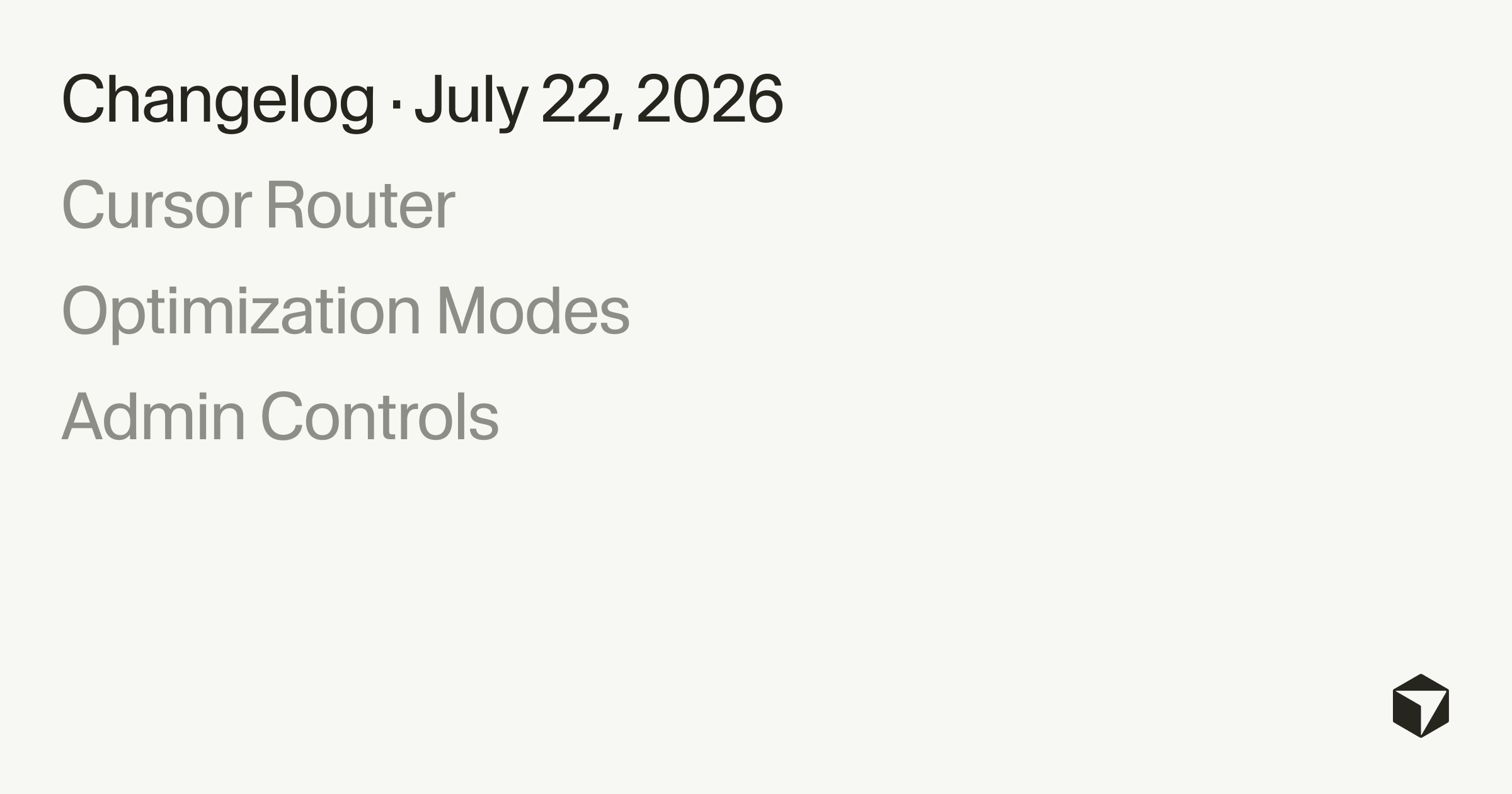
Cursor turns Auto mode into Cursor Router, an intelligent model router

Cursor shipped Cursor Router, which now powers Auto mode by classifying each request by task type and complexity and routing it to a frontier model or a price-efficient one.

Users pick an optimization target — Intelligence, Balance or Cost — and admins can enable the router per team or group, restrict which modes members use, set the default mode, and allow or block underlying models, with soft or hard enforcement for standardizing on Auto. The router is available across desktop, web, iOS, CLI and Cursor's SDK, is on by default for Teams plans, and requires Grok 4.5 as a price-efficient routing option.

Cursor turns Auto mode into Cursor Router, an intelligent model router
ptht05hbb1ssoooe.public.blob.vercel-storage.com

WHY IT MATTERS

Model routing is becoming the core cost lever inside agent harnesses — and Cursor is now shipping the policy controls enterprises were asking for.

TUE · Jul 21, 2026modelsgoogleagentsefficiencysecurity

Google ships three Flash-tier Gemini models and confirms Gemini 4 pre-training

Google introduced Gemini 3.6 Flash, 3.5 Flash-Lite and 3.5 Flash Cyber, aimed squarely at production agent workloads: 3.6 Flash cuts output token usage by 17% versus 3.5 Flash on the Artificial Analysis Index, and up to 65% on Datacurve's DeepSWE, at a lower cost per output token, while 3.5 Flash-Lite is pitched as the fastest, cheapest 3.5-class model.

3.5 Flash Cyber ships paired with the CodeMender code-security agent. Google also said Gemini 3.5 Pro is still testing with partners and that it has started our most ambitious pre-training run yet, for Gemini 4.

WHY IT MATTERS

Cheaper, more token-efficient Flash models plus a specialized cyber agent are direct inputs to any agent pipeline that has to survive a budget.

TUE · Jul 21, 2026open weightscodingagent harnessmodelspoolside

Poolside releases Laguna S 2.1, a 118B open-weight agentic coding model

Poolside released Laguna S 2.1, a 118B total and 8B activated MoE model with up to a 1M-token context in thinking and no-thinking modes, under the OpenMDW-1.1 open license and small enough to run on a single desktop.

It scores 70.2% on Terminal-Bench 2.1 in Poolside's own harness and is pitched as the most capable agentic coding model in its weight class, holding its own against models several times larger. Poolside says it went from the start of training to launch in under nine weeks and is publishing full trajectories for every benchmark trial it reports.

WHY IT MATTERS

A genuinely open-weight, laptop-class agentic coding model with published trajectories is the kind of reproducibility the open-weights crowd has been asking for.

MON · Jul 20, 2026computehardwareamdazureinference

Microsoft brings AMD's Helios rack-scale AI platform to Azure

Microsoft said Azure will add AMD's Helios AI platform and next-generation EPYC datacenter processors to its fleet, powering three upcoming offerings: HDv2 VMs for AI data systems and agentic workloads, HXv2 VMs for electronic design automation and technical computing, and ND MI455X v7 VMs for production-scale AI inference.

The move expands Microsoft's heterogeneous, multi-silicon strategy for inference and gives AMD its largest rack-scale design win yet in its push against Nvidia.

WHY IT MATTERS

Inference capacity and silicon choice set the floor on token prices, and AMD landing a hyperscaler is the strongest signal yet that the AI compute supply base is broadening.

MON · Jul 20, 2026copyrightlawsuitsanthropicpolicy

Judge approves Anthropic's $1.5B author copyright settlement — the first major AI-training case to close

US District Judge Araceli Martinez-Olguin granted final approval to Anthropic's $1.5 billion class-action settlement with authors who said the company trained Claude on pirated books, calling it meaningful relief for affected authors and publishers.

The deal covers more than 482,000 titles at roughly $3,000 per work, with about 91% already claimed by authors or publishers; the judge cut the requested attorney fee by $86 million, leaving $122 million for plaintiff counsel. It is the largest known copyright recovery in US history and the first major AI-training copyright case to reach full resolution, with parallel author suits against OpenAI and Meta still pending.

WHY IT MATTERS

The first resolved AI-training copyright case sets the price of the piracy claim and will shape settlement posture in every other author suit.

DISPATCH 81

WEEK OF JUL 11 – 17, 2026

Open weights close the gap as Washington tightens the gate

The open-weight frontier jumped twice in 48 hours, Brussels forced Android open to rival assistants, and reporting suggested the White House now shapes who gets frontier models.

Thinking Machines shipped Inkling and Moonshot shipped a 2.8-trillion-parameter Kimi K3 inside two days, pulling the open-weight ceiling up from both ends — a 42B-active model you can fine-tune and a 3T-class system you cannot yet download.

The EU ordered Google to give third-party AI assistants the same Android access as Gemini, and CNBC reported that a new government-private cyber clearinghouse has become the practical gate on frontier access.

FRI · Jul 17, 2026policyregulationfrontier modelsus government

White House now shapes who gets frontier models, via new 'Gold Eagle' clearinghouse

CNBC reported on July 17, citing two people familiar with the matter, that the Trump administration now effectively dictates which companies and entities get access to the newest frontier models — a job that previously sat with Anthropic's Project Glasswing and OpenAI's Daybreak.

A source tied that authority to Gold Eagle, a government-private cyber clearinghouse launched this week to find and patch vulnerabilities. A White House official pushed back, saying participation in testing and meetings is voluntary, that the administration does not provide approvals for private releases, and that timing and scope rest with the companies — pointing to Trump's June 2 executive order, which explicitly disclaims any mandatory licensing or preclearance regime. The backdrop is a squeeze in both directions: the administration blocked Anthropic's Mythos 5 and Fable 5 last month on national-security grounds before restoring access after negotiations, and OpenAI's GPT-5.6 went public only after a gated rollout to government-cleared partners.

White House now shapes who gets frontier models, via new 'Gold Eagle' clearinghouse
image.cnbcfm.com

WHY IT MATTERS

If government sign-off becomes the practical default for flagship releases, the availability of your model vendor becomes a policy variable, not just a pricing one. Note that the access claim itself rests on thin sourcing, unlike the confirmed executive order and clearinghouse.

THU · Jul 16, 2026open weightsmodel releasemoonshotagent harnessesbenchmarks

Moonshot launches Kimi K3, a 2.8T-parameter open-weight model, at WAIC

Moonshot AI released Kimi K3 on July 16, marketing it as the first open 3T-class model: a sparse mixture-of-experts system with 2.8 trillion total parameters that activates 16 of 896 experts per token, a 1-million-token context window and native vision.

Two architecture changes carry the claims — Kimi Delta Attention for scaling across sequence length and Attention Residuals for selective depth-wise retrieval — which Moonshot says yield roughly 2.5x better scaling efficiency than Kimi K2, a vendor figure that has not been independently reproduced. It ships always-on max reasoning, prices at $0.30 per million cache-hit input tokens, $3.00 cache-miss input and $15.00 output, and is live on Kimi.com, Kimi Work, Kimi Code and the API. The catch: the weights, promised under a new Kimi K3 license, were not downloadable until July 27, so the largest-open-model-ever billing was unverifiable at launch. Moonshot's benchmark footnotes also lay out exactly which agent harness — Kimi Code, Claude Code or Codex — scored what.

WHY IT MATTERS

Directly relevant if you route coding agents: the harness is now part of the published score, so benchmark tables are not comparable across vendors. It is also the clearest signal yet that open weights trail the closed frontier by weeks, not years.

THU · Jul 16, 2026regulationeudmaagentsandroid

EU orders Google to open Android to rival AI assistants and share Search data

The European Commission issued two sets of binding specification measures to Google under the Digital Markets Act on July 16. The first requires that third-party AI assistants get the same Android access as Gemini: users must be able to wake their chosen assistant by voice, similar to Hey Google, and delegate actions inside apps — booking a taxi, suggesting chat replies, answering questions about a recently visited place.

The second specifies how Google shares Search data with rival search engines, including making AI chatbots with search features eligible, with a multi-layered anonymization method and a published formula for pricing access. Google must start sharing search data from January 2027, and the Android changes reach users from July 2027. Google's global affairs chief Kent Walker called the measures unprecedented risks to user privacy, device security and national security. Because these are specification proceedings rather than non-compliance investigations, they carry no fines — but they are legally binding.

EU orders Google to open Android to rival AI assistants and share Search data
www.engadget.com

WHY IT MATTERS

The interesting part for builders is agentic: a regulator is mandating that a third-party assistant can act across apps on a user's behalf, which is exactly the delegation and permissioning surface your agent has to get right.

WED · Jul 15, 2026open weightsmodel releasethinking machinesfine-tuningagentic coding

Thinking Machines releases Inkling, its first model — and it's open-weight

Mira Murati's Thinking Machines Lab published Inkling on July 15, its first foundation model: a mixture-of-experts transformer with 975 billion total parameters and 41 billion active, up to a 1M-token context, pretrained on 45 trillion tokens of text, images, audio and video.

It was trained from scratch with encoder-free audio and vision inputs, shipped under an Apache 2.0 license, and paired with the company's Tinker fine-tuning platform at 64K and 256K context options. The framing is unusually blunt: the blog states Inkling is not the strongest overall model available today, open or closed, and positions it as a customizable base rather than a leaderboard winner. On agentic coding the company claims Inkling hits the same Terminal Bench 2.1 performance as Nvidia's Nemotron 3 Ultra using one third the tokens, and the model exposes a controllable thinking effort dial. WIRED notes Thinking Machines used Inkling to fine-tune and improve itself, and that its chain of thought got terser over training while outputs stayed the same.

WHY IT MATTERS

A genuinely open, multimodal base you can fine-tune yourself — the anti-one-size-fits-all bet. If you self-host coding agents, this and Kimi K3 pull the open-weight ceiling up from both ends: 42B active versus 2.8T total.

MON · Jul 13, 2026fundingagent harnessesopen sourcenous research

Nous Research, maker of the open-source Hermes agent, raises at a $1.5B valuation

TechCrunch reported on July 13, citing three sources, that Nous Research is finalizing a round of at least $75 million at a $1.5 billion valuation, led by Robot Ventures with significant participation from Union Square Ventures.

The company had raised roughly $70 million cumulatively before this, including a $50M Series A led by Paradigm, so the new round alone is larger than everything that came before it. The pitch hinges on Hermes, the open-source agent framework: the company says it can learn from usage and build skills without manual intervention, and users run it on a desktop or VPS, chatting with agents through Telegram and Discord. GitHub numbers cited in the report put Hermes at roughly 214,000 stars and nearly 40,000 forks.

WHY IT MATTERS

Funding for the harness layer, not the model layer — the open-source agent going head-to-head with the closed consumer assistants. Useful as a data point for whether open code plus paid hosting is being underwritten as a real business model.

ARCHIVE

Go back in time

Every dispatch, newest first. Each week is written once and left as it was published.